If your white UPVC conservatory is starting to look tired, yellowed, or just plain dated, you are not alone. Millions of conservatories were built across the UK between the late 1990s and early 2010s, and the vast majority were finished in standard white UPVC. Twenty years on, many of those conservatories are still structurally sound but look like they belong to a different era.
The good news is that you do not need to replace your conservatory to make it look modern again. Professional UPVC spraying can completely transform the appearance of a conservatory, changing it from a dated white box into something that looks like a purpose-built contemporary extension. It is one of the most dramatic home improvements you can make for the money.
In this guide, I will cover everything you need to know about conservatory spraying: whether it works, what is involved, how much it costs, which colours work best, and what you can realistically expect from the finished result. After more than 11 years of spraying conservatories across the UK, I have seen every shape, size, and condition imaginable, so I will share the practical insights that only come from hands-on experience.
Yes, absolutely. Conservatory spraying uses the same professional 2K polyurethane paint system that we use on windows and doors. The paint bonds chemically to the UPVC surface, creating a durable, weather-resistant finish that is designed to last 10 years or more. We have sprayed conservatories in every part of the UK, from the Scottish coast to the south of England, and the finish performs consistently well in all conditions. If you have broader questions about whether UPVC spraying holds up over time, our guide on does UPVC spraying work covers the science and the real-world evidence in detail.
The reason conservatory spraying is so effective is that the UPVC framework of a conservatory is the same material as your windows and doors. If you can spray a window frame, you can spray a conservatory. The only difference is scale. A conservatory has more framework, more complex angles, and more surface area, which means the project takes longer and requires more skill, but the fundamental process and the end result are the same.
What Parts of a Conservatory Can Be Sprayed?
A UPVC conservatory is made up of several different components, and most of them can be sprayed.
Window and Door Frames
All of the UPVC window frames, opening casements, and door frames within the conservatory can be sprayed. These are treated in exactly the same way as standalone UPVC windows elsewhere on the property. The frames are cleaned, degreased, abraded, primed, and sprayed with 2K polyurethane paint.
Roof Bars and Ridge
If your conservatory has a UPVC roof structure, the bars, ridge cap, and hip joints can all be sprayed. This is important because the roof framework is often the most visible part of the conservatory from a distance, and yellowed or chalky roof bars can make the whole structure look neglected. Spraying the roof bars makes a significant difference to the overall appearance.
Fascia, Soffit, and Guttering
The external fascia boards, soffit panels, and guttering around the conservatory are usually UPVC and can be sprayed to match the frames. Doing these at the same time as the main framework gives the conservatory a completely cohesive, unified look.
UPVC Cladding and Panels
Some conservatories have solid UPVC panels below the windows rather than full-height glazing. These can also be sprayed to match the rest of the structure. The panels are prepared and painted in exactly the same way as the frames.
What Cannot Be Sprayed
Glass and polycarbonate roofing panels cannot be sprayed, obviously. Aluminium components, if present, can be sprayed but may require a different primer. Rubber seals and gaskets are masked and protected during the spraying process, not painted. If your conservatory has a tiled or solid roof, the tiles or panels are not sprayed, but any UPVC trim around them can be.
Best Colours for Conservatory Spraying
The colour you choose for your conservatory will have a huge impact on how the finished result looks. Here are the most popular options we see.
Anthracite Grey (RAL 7016)
By far the most popular choice for conservatory spraying, just as it is for windows and doors. Anthracite grey transforms a dated white conservatory into something that looks like a modern aluminium-framed extension. The dark colour hides the framework visually, making the glass appear more prominent and the overall structure look sleeker and more contemporary. It works on virtually every property type.
Agate Grey (RAL 7038)
A softer, warmer grey that is an excellent choice if you find anthracite a little too dark or if your property has a softer palette of colours. Agate grey gives the conservatory a modern update without the dramatic contrast of a very dark frame.
Matching Your Windows
If you are having your house windows sprayed at the same time as the conservatory, matching the colour across both is usually the best approach. It creates a unified, intentional look that ties the conservatory into the rest of the property. Choosing different colours for the conservatory and the house can look disjointed unless the contrast is deliberate and well considered. For a full rundown of popular shades, see our UPVC paint colours guide.
Chartwell Green and Heritage Colours
For period properties or homes in conservation areas, softer heritage colours like chartwell green, sage green, or cream can give a conservatory a more traditional feel that sits comfortably with the character of the house. These colours are particularly popular on Victorian-style conservatories and orangeries.
How Much Does Conservatory Spraying Cost?
Conservatory spraying costs more than a set of windows because there is simply more surface area to prepare and paint. However, it is still a fraction of the cost of replacing the conservatory entirely.
Typical Pricing
A small lean-to conservatory with minimal framework typically costs between £600 and £1,000 to spray. A medium-sized Edwardian or Victorian conservatory usually falls between £1,000 and £1,800. Larger P-shaped or wraparound conservatories can be £1,500 to £2,500 or more depending on complexity and access requirements. These prices include full preparation, professional 2K paint, and a 10-year guarantee.
Conservatory Spraying vs Replacement
Replacing a conservatory entirely typically costs between £8,000 and £25,000 depending on the size, style, and specification. Even at the top end of spraying costs, you are paying roughly 10 to 15 per cent of the replacement price for a result that makes the existing structure look brand new. The conservatory itself is usually still structurally sound, with years of life left in the frames, glass, and seals. Spraying makes financial sense in the vast majority of cases.
For a full pricing breakdown covering windows, doors, and conservatories, see our UPVC spraying cost guide.
How Does Conservatory Spraying Work? Step by Step
Assessment and Quote
We start with a free site visit to assess the conservatory. We check the condition of the UPVC, the type of roof, access requirements, and any specific challenges. We discuss colour options and provide a clear written quote that covers everything.
Preparation
On the day of the project, we begin by masking all glass panels, seals, brickwork, paving, and any garden furniture or plants nearby. Every UPVC surface is then thoroughly cleaned with a specialist UPVC cleaner, degreased with a solvent wipe, and lightly abraded to create a key for the paint. An adhesion promoter is applied and allowed to flash off. This preparation stage is the most time-consuming part of the project but it is what makes the finish last. Our UPVC preparation guide explains each step in detail.
Spraying
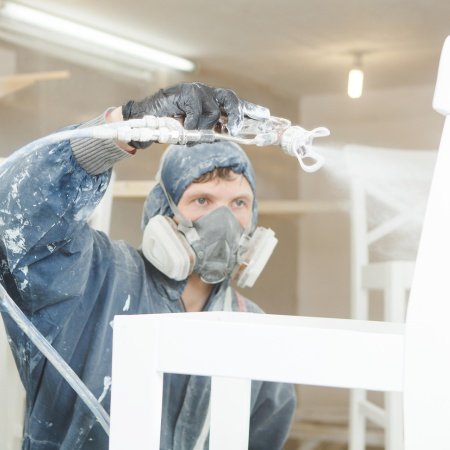
We apply the 2K polyurethane paint using professional airless spraying equipment. The paint is applied in thin, even coats, building up the colour gradually for a smooth, consistent finish. Conservatories require careful spray technique because of the complex angles, tight spaces between roof bars, and the need to avoid overspray on glass panels. This is where experience really matters.
Finishing
Once the final coat has tacked off, we remove all masking carefully and inspect the entire conservatory for even coverage and clean edges. Any minor touch-ups are completed at this stage. The whole project is typically finished in a single day for a standard-sized conservatory, or two days for larger or more complex structures.
Curing
The paint is touch-dry within a couple of hours, but full curing takes 24 to 48 hours. During this time, we recommend keeping conservatory windows closed if possible and avoiding touching or leaning anything against the freshly painted surfaces. After 48 hours, the finish is fully hardened and the conservatory can be used normally.
Things to Consider Before Spraying Your Conservatory
Heat Absorption and Dark Colours
A common concern is whether dark colours like anthracite grey will cause the conservatory to overheat. In practice, the colour of the UPVC framework has minimal impact on the internal temperature of the conservatory because the framework represents a small proportion of the total surface area. The glass panels, roof material, ventilation, and orientation of the conservatory are far more significant factors in determining how hot it gets. We have sprayed thousands of conservatories in dark colours and have never had a report of heat-related issues with the UPVC.
Polycarbonate vs Glass Roofs
The type of roof does not affect whether the framework can be sprayed. Whether your conservatory has a polycarbonate roof, glass panels, or a solid tiled roof, the UPVC bars and trim around it can all be sprayed. We mask and protect the roofing material during the process, regardless of what it is.
Conservatory Age and Condition
We can spray conservatories of any age, from relatively new builds to structures that are 25 years old or more. The only requirement is that the UPVC is structurally sound. If the frames are cracked, warped, or if the sealed units have failed extensively, it may be worth considering whether some remedial work is needed before spraying. During our site visit, we will be honest about the condition and let you know if there are any issues to address first.
Planning Permission
In most cases, spraying a conservatory does not require planning permission because you are not altering the structure. However, if your property is in a conservation area or is a listed building, it is always worth checking with your local planning authority before committing to a colour change. Heritage colours like cream, green, and muted greys are usually accepted even in sensitive areas.
Conservatory Spraying Before and After
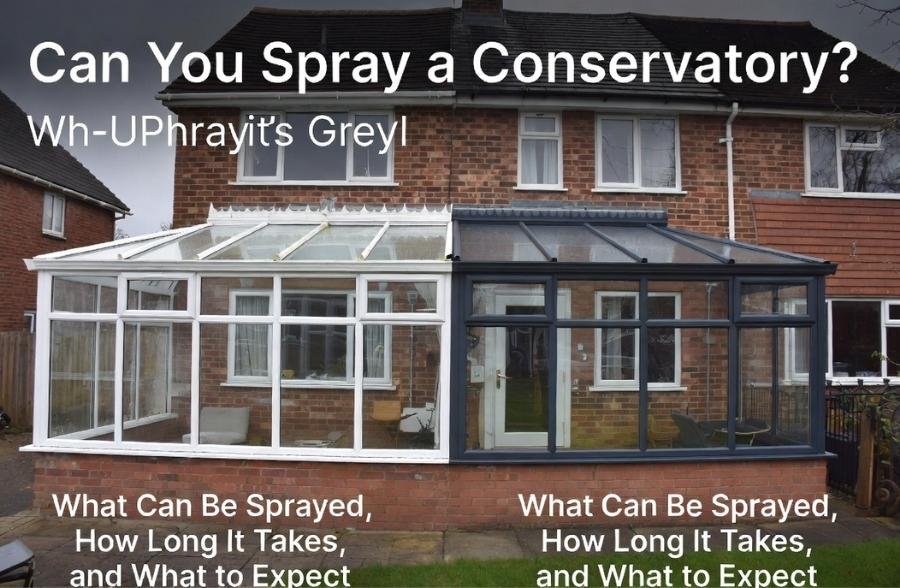
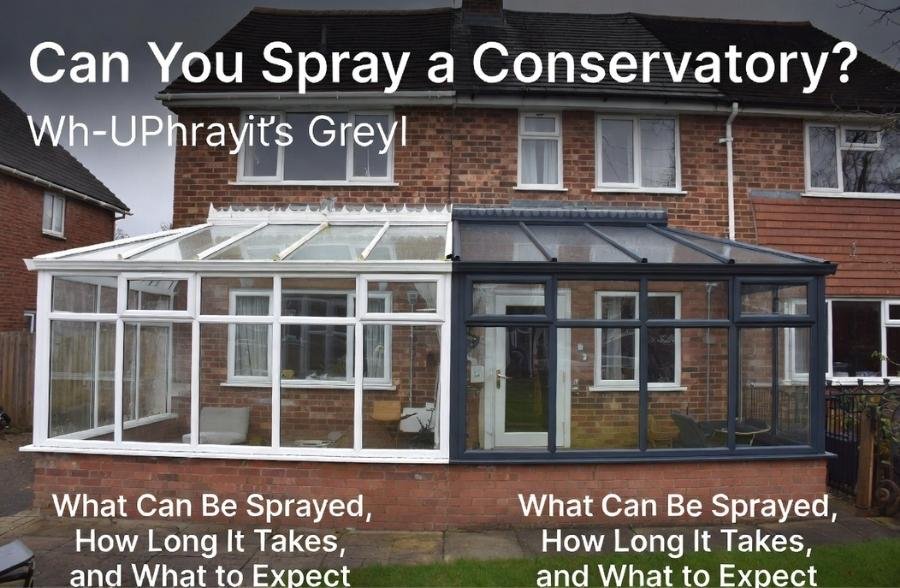
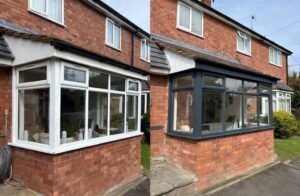
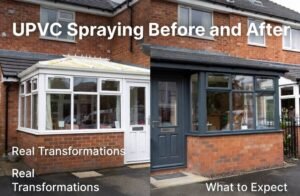
The visual transformation of a sprayed conservatory is one of the most dramatic changes we deliver. A white conservatory that has been in place for 15 to 20 years typically looks faded, slightly yellow, and very clearly dated. After spraying, the same structure looks like a modern, purpose-built extension that was designed to complement the house.
The impact is even more striking when the conservatory is sprayed to match the house windows and doors. Suddenly the conservatory looks like an integral part of the property rather than an afterthought. We share regular project photos on our website and social media, and our before and after gallery shows real examples of conservatory transformations.
[Add: Before and after photos of conservatory spraying projects here]
Conservatory Spraying vs Other Upgrade Options
Spraying vs Replacement
Full conservatory replacement is the most expensive option, typically costing £8,000 to £25,000. It makes sense if the structure is failing or if you want to change the size, shape, or layout. If the conservatory is structurally sound and you simply want to update its appearance, spraying at £600 to £2,500 achieves the same visual result at a fraction of the cost.
Spraying vs UPVC Restorer Products
UPVC restorer creams and liquids can temporarily improve the appearance of faded white UPVC, but the effect is superficial and short-lived. These products do not change the colour, they simply clean the surface and add a temporary gloss. The improvement typically lasts a few months at best before the UPVC returns to its previous state. Spraying is a permanent colour change that lasts 10 years or more.
Spraying vs Conservatory Roof Replacement
Many homeowners replace their conservatory roof with a solid tiled roof to improve insulation and reduce the dated appearance. This is a worthwhile upgrade but it only addresses the roof. If the UPVC framework below is still white and tired-looking, the overall effect can be undermined. Spraying the UPVC framework is an excellent complement to a roof replacement, giving the entire structure a cohesive, modern appearance.
Spraying Plus a New Roof
The combination of a new solid roof and freshly sprayed UPVC framework is one of the most transformative upgrades you can make to a conservatory. The solid roof improves insulation and usability, while the sprayed framework modernises the appearance. Together, they can turn a dated conservatory into a genuine year-round living space that adds real value to your home.
Frequently Asked Questions
Can you spray a conservatory roof?
If the conservatory roof is made of UPVC panels, yes, the panels can be sprayed. However, most conservatory roofs are either glass or polycarbonate, which cannot be sprayed. The UPVC bars, ridge caps, and trim around glass or polycarbonate roof panels can all be sprayed, which significantly improves the overall appearance.
How long does conservatory spraying take?
A standard conservatory can usually be sprayed in a single day, including all preparation and masking. Larger or more complex conservatories may take a day and a half or two days. The conservatory is usable again the same day, though we recommend avoiding touching the painted surfaces for 24 to 48 hours while the paint fully cures.
Can I use the conservatory while it is being sprayed?
Yes, in most cases. The spraying is done from the outside, so you can continue to use the conservatory during the project. We will let you know if there are any periods where it would be helpful to keep specific doors or windows closed to avoid overspray, but there is no need to vacate the conservatory or clear it of furniture.
Will the paint affect my conservatory blinds or curtains?
No. All internal fittings are protected from overspray because we mask the external surfaces and spray from outside. Your blinds, curtains, and internal finishes are completely unaffected.
Can you spray a conservatory that has already been painted?
Yes, provided the existing paint is sound and well-adhered. If the previous paint is peeling or flaking, it will need to be removed before we can apply a fresh coat. During our site visit, we assess the condition of any existing paintwork and advise on the best approach.
Is conservatory spraying messy?
No. Professional masking protects all glass, seals, brickwork, paving, and surrounding areas. We also cover any garden furniture, plants, or other items near the conservatory. At the end of the project, we remove all masking and clean up the site. You should not find any paint where it should not be.
Can I spray my conservatory myself?
Conservatories are one of the projects where I would strongly recommend hiring a professional rather than attempting DIY. The complex angles, roof bars, tight spaces, and large surface area make it very difficult to achieve an even finish without professional spray equipment and experience. The risk of an uneven, patchy, or dripping finish is high, and correcting mistakes on a conservatory is much harder than on a single window. If you want to understand the DIY vs professional decision in more detail, our guide on whether you can spray UPVC yourself covers the pros and cons honestly.
Transform Your Conservatory Today
At UPVC Spray Team, conservatory spraying is one of our most popular services. We have transformed conservatories of every size and style across the UK, from small lean-tos to large wraparound structures. Every project includes full preparation, professional 2K polyurethane paint, and our 10-year guarantee. Get a free quote and find out how little it costs to completely change the look of your conservatory.
Transform your windows, doors & conservatories with our professional UPVC spray painting service
About Paul
UPVC Spray Painting Expert
Hi, I’m Paul from UPVC Spray Team! With over 11 years of experience in UPVC spray painting, I’ve helped countless homeowners revive their windows, doors, kitchens, and furniture. My goal is simple: to give your home a fresh, like-new look without the cost of replacements.
I use eco-friendly materials and proven techniques to ensure every project is durable, clean, and hassle-free. Whether it’s restoring faded UPVC or updating your garage door, I focus on quality and your satisfaction.
You’ve probably seen my tips on saving money and home care here on the blog—I love sharing practical advice to make your life easier. Trust me and the Spray Team to transform your space efficiently and affordably.
✓ 10-Year Guarantee On All Work
Paul and his team did an amazing job transforming our tired white windows to a modern anthracite grey. The finish is flawless and has completely modernized our home. Highly recommended!
We couldn't believe the transformation! Our conservatory looks brand new and the color perfectly matches our new extension. Paul was professional from start to finish.
If your white UPVC conservatory is starting to look tired, yellowed, or just plain dated, you are not alone. Millions of conservatories were built across the UK between the late 1990s and early 2010s, and the vast majority were finished in standard white UPVC. Twenty years on, many of those conservatories are still structurally sound […]
It is a fair question. If UPVC spraying is essentially cleaning, prepping, and painting a plastic surface, surely you can do it yourself and save a few hundred pounds? The honest answer is: technically, yes, you can spray UPVC yourself. But in practice, the gap between a DIY result and a professional finish is enormous. […]
There is nothing quite like seeing a real before-and-after transformation to understand what UPVC spraying can do for a property. Photos tell the story better than words ever could, and they are usually what convinces homeowners to go ahead with a project. Over the past 11 years, we have sprayed thousands of properties across the […]
If you are looking into UPVC spraying, the first question on your mind is almost certainly: how much is this going to cost? It is a fair question, and one that deserves a straight answer rather than the vague "prices from..." you see on most websites. The truth is that UPVC spraying costs vary depending […]
Choosing the right colour for your UPVC spray painting project is one of the most exciting parts of the process, but it can also feel overwhelming. With over 1,600 RAL colours available and dozens of popular shades to consider, how do you narrow it down? After more than 11 years of spraying UPVC across the […]
If you’re Googling “uPVC window painting cost”, you probably want one simple thing, a clear price you can trust. I get it. Pricing online is often vague, and it’s easy to end up comparing apples to oranges. One company quotes “from £75”, another says “£200 per window”, and suddenly you’re none the wiser. I’m Paul […]
When it comes to refreshing your home’s appearance, UPVC spray painting is one of the most cost-effective and efficient solutions available. Whether you’re looking to update your windows, doors, or even furniture, spray painting offers a durable, long-lasting finish that can transform your space. At UPVC Spray Team, we’ve seen firsthand how this service can breathe new life […]
Spray painting UPVC windows is a fantastic way to refresh your home’s appearance without the cost of replacement. However, the key to a long-lasting, professional finish lies in proper preparation. In this blog, we’ll guide you through the steps to prepare UPVC windows for spray painting, ensuring a smooth and durable result. Why Preparation Matters Preparation […]
When it comes to spray painting, especially for outdoor projects like UPVC windows, doors, or furniture, one of the most important questions is: Is spray paint UV resistant? UV resistance is crucial because it determines how well the paint can withstand sunlight without fading, cracking, or peeling. What Does UV-Resistant Spray Paint Mean? UV-resistant spray paint is […]
Painting UPVC windows inside is possible and can refresh your home’s look. But it requires careful steps to avoid problems. Let’s explore how to do it safely and effectively. Can You Paint UPVC Windows Indoors? Yes! Painting UPVC windows inside is a simple way to update your space. However, proper preparation, good materials, and safety steps are key to […]
Spray painting UPVC windows is a cost-effective way to improve your home’s look. But how long does it last? With proper care, spray-painted UPVC windows can stay fresh for 8–12 years. Let’s break down the factors that affect their lifespan and how to make the results last. What Affects the Lifespan of Spray-Painted UPVC Windows? Tips […]
Spray painting indoors (e.g., furniture, cabinets, or doors) can deliver a flawless finish, but prep is everything. Skip this step, and you’ll risk dust-filled paint, sticky overspray on your floors, or fumes lingering for days. Here’s how to prep a room like a pro, using simple, budget-friendly tips. Why Room Prep Matters Tools You’ll Need Step […]
Choosing between a spray gun and a paint brush can make or break your painting project. Both tools have their place, but understanding their strengths and weaknesses ensures you pick the right one for furniture, kitchens, UPVC, or garage doors. Let’s break it down in plain terms. 5 Advantages of Using a Spray Gun 5 […]
Spray painting metal surfaces like garden furniture, garage doors, railings, and window frames can give them a fresh, durable finish. But skip one critical step and you could be left with peeling paint, visible rust, and a finish that barely lasts a few weeks. So do you really need to sand metal before spray painting? […]
Spray painting can transform old furniture, kitchens, or UPVC windows and doors, giving them a fresh, like-new finish. But to get professional results, you need the right tools—and one of the most important is your air compressor. Choosing the wrong size can lead to uneven finishes, frustrating stops and starts, or even damage your equipment. […]
If your kitchen worktops—or countertops, if you prefer—look scuffed, scratched, or have become dull over the years, you might be considering an upgrade. Maybe you’re after a fresh look or a color change to align with current trends. However, replacing worktops can be expensive, time-consuming, and potentially messy, involving risks to tiles, plumbing, and cabinets. […]
Traditional vs. Modern Techniques While traditional brushes and rollers have their place, spray painting offers unparalleled advantages for exterior house painting. The Benefits of Spray Painting Rapid Completion: Spray painting significantly reduces project timelines, allowing your home to be transformed quickly and efficiently. Seamless Finish: Fine droplets of paint create a smooth, even coating that […]
uPVC windows and doors are a standard feature in most new homes across the UK, basically because they are cost-effectiveness, low maintenance, and impressive durability. When properly cared for, these features can last between 25 to 35 years. However, over time, they begin to show signs of weathering. White uPVC is particularly prone to yellowing […]
Spray painting uPVC has become a popular and cost-effective way to refresh and modernise the appearance of doors, windows, and conservatories. But to achieve a flawless, long-lasting finish, choosing the right spray paint is crucial. Why Choose the Right Paint? uPVC (unplasticised polyvinyl chloride) is a durable but non-porous material. This means that ordinary paint […]
Spray painting your uPVC window frames is an excellent way to give your home a fresh, modern look without the expense and hassle of replacing the windows entirely. At uPVC Spray Team, we specialise in delivering a flawless factory finish that not only enhances the aesthetic appeal of your property but also ensures long-lasting durability. […]
Updating your kitchen cupboards with a fresh coat of paint is an affordable way to transform your kitchen's look without a full renovation. Preparation Checklist Tools and Materials Step-by-Step Painting Process Step 1: Prepare the Area Step 2: Clean Surfaces Step 3: Sand Surfaces Step 4: Apply Primer Step 5: First Paint Coat Step 6: […]
First impressions matter, and the exterior of your house plays a key role in defining your property’s appeal and value. Whether you’re aiming to refresh tired walls or completely transform your home’s look, exterior house painting is a practical and impactful solution. This guide will explore everything from preparation to professional spray painting options, ensuring […]
Painting a UPVC door is a cost-effective way to modernise your home and refresh its look. Whether you have a dated white or wood-effect UPVC door, painting can transform it into a stylish feature without the need to replace it entirely. Here's a comprehensive guide on how to paint a UPVC door, including preparation tips, […]
Airless spraying is a new way to paint things. It uses strong pumps to spray paint very finely, without needing air. This makes it faster and more accurate, giving a smooth finish. Professional Airless Spraying Services Speed and Efficiency Airless spraying is incredibly fast, capable of applying paint up to ten times faster than traditional […]
Spray painting UPVC windows is becoming an increasingly popular choice for homeowners who want to enhance their property’s aesthetics without breaking the bank. This cost-effective and efficient alternative to replacement offers numerous advantages, from improving appearance to extending the life of your windows. In this post, we’ll explore the top five benefits of spray painting […]
When it comes to plastic materials used in construction, windows, doors, and plumbing, you'll often hear about PVC and uPVC. What is PVC? PVC, or Polyvinyl Chloride, is a lightweight and versatile plastic widely used in construction, electronics, and consumer goods. Characteristics: Disadvantages: What is uPVC? uPVC stands for Unplasticised Polyvinyl Chloride. It is essentially […]
uPVC windows are durable, low-maintenance, and cost-effective. However, over time, they can fade, or you might simply want to update their colour. One common question we get asked is, "Can you paint uPVC windows?" The answer is yes, but to ensure a lasting and professional finish, you need to follow the right steps. In this […]
To provide the best experiences, we use technologies like cookies to store and/or access device information. Consenting to these technologies will allow us to process data such as browsing behavior or unique IDs on this site. Not consenting or withdrawing consent, may adversely affect certain features and functions.
Functional
Always active
The technical storage or access is strictly necessary for the legitimate purpose of enabling the use of a specific service explicitly requested by the subscriber or user, or for the sole purpose of carrying out the transmission of a communication over an electronic communications network.
Preferences
The technical storage or access is necessary for the legitimate purpose of storing preferences that are not requested by the subscriber or user.
Statistics
The technical storage or access that is used exclusively for statistical purposes.The technical storage or access that is used exclusively for anonymous statistical purposes. Without a subpoena, voluntary compliance on the part of your Internet Service Provider, or additional records from a third party, information stored or retrieved for this purpose alone cannot usually be used to identify you.
Marketing
The technical storage or access is required to create user profiles to send advertising, or to track the user on a website or across several websites for similar marketing purposes.